
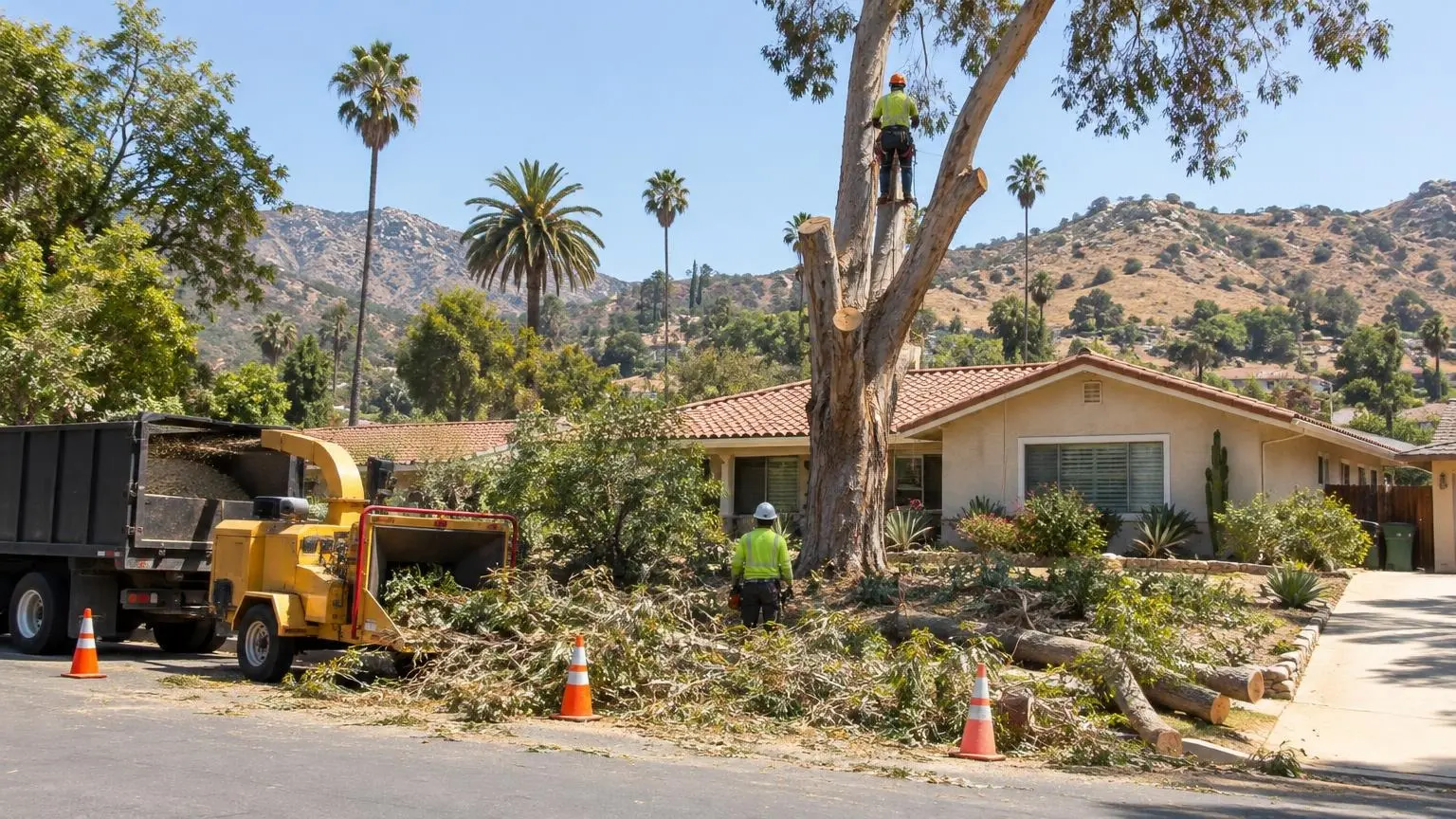
A valley city of about 151,000 with hills on three sides
Tree Removal in Escondido, CA
From Victorian lots near Grand Avenue to hillside parcels above Dixon Lake.
- No-cost estimates at your property in Escondido and nearby towns
- Your quote, in writing, itemized by tree
- Cleanup plan agreed before work starts
Taking Trees Down in a City Built on Orchards
Tree Removal in Escondido usually starts with one question: what kind of tree is it? The city's zoning code treats oaks differently from almost everything else, and many yards here still hold trees left over from the citrus, olive, walnut and avocado plantings that once covered the valley. A dead lemon tree in a backyard on the east side and a 14-inch coast live oak on a hillside lot in the north are two very different jobs, and the paperwork, if any, depends on which one you have.
The oak rule most homeowners have not heard of
Escondido's grading and erosion chapter defines a "mature tree" as an oak with a trunk of at least 4 inches in diameter, or any other tree of at least 8 inches, measured 4.5 feet above natural grade. A "protected tree" is any oak of 10 inches or more, plus trees listed on the local historic register. The code says no one may destroy, clear, trim or cut protected trees in violation of the chapter, and when mature trees cannot be kept they are replaced at a minimum one-to-one ratio, with protected trees at two-to-one. Before we schedule work on an oak, we measure it with you and talk through whether a call to the Planning Division makes sense first.
Pruning has limits too
The same section describes routine maintenance as pruning no more than one-third of the living crown at a time, and it says pruning shall not involve topping. That matches the ANSI A300 approach most arborists already follow. If an oak is crowding the roof, a reduction cut or a few well-placed removals of whole limbs is usually the better answer than taking the tree out, and it keeps you on the right side of the code.
Old Escondido and the historic core
The Old Escondido Historic District runs roughly from Escondido Boulevard to Chestnut Street and from Fifth Avenue to Thirteenth Avenue, and it is mostly Victorian and Craftsman homes from the late 1800s and early 1900s. Under the city code for that neighborhood, a project that removes or relocates a mature or protected tree is also subject to the tree sections above, and exterior changes follow the district's design guidelines. Big pepper trees, palms and old shade trees on narrow lots with detached garages and alley access are common there, and those lots often call for piece-by-piece removal with rigging rather than felling.
Street trees belong to a different conversation
A tree in the parkway or along the street edge may be the city's tree. In 2016, ABC 10News covered a dispute over a city-owned pepper tree on Second Avenue that the city said was lifting the road and blocking sight lines. That story also noted city rules calling for one tree per 30 feet of street frontage and 24-inch box replacements for mature trees removed under the grading ordinance. If the trunk sits outside your property line, call the city before anyone cuts it.
What we see on Escondido lots
- Leftover grove trees, often citrus or avocado, declining after years without irrigation
- Eucalyptus and pepper trees planted as windbreaks that are now taller than the house
- Oaks in the hills toward Daley Ranch and Lake Wohlford, where the city's oak rules matter most
- Palms in front yards near downtown that need dead fronds and fruit stalks cleared, or removal when they lean
- Riparian trees, such as sycamores and willows, near Escondido Creek and its tributaries
- Stumps left from earlier removals that block replanting
Heat, wind and dry years
Escondido's record high is 115 degrees, set on September 6, 2020, and the driest rain year on record, July 2013 through June 2014, brought only 5.75 inches. More than 80% of the rain falls from November through March. Drought-stressed trees drop limbs in summer heat with no wind at all, so a tree that has thinned badly over a dry year deserves a look before the fall Santa Ana season.
Getting a price
We come out, look at the tree, check for oaks, power lines and access, and write down a price that includes cleanup and hauling. If grinding the stump makes sense, it is listed as its own line so you can decide. Get a free estimate
Escondido Tree Rules and Conditions
- Oaks are measured early. Escondido Municipal Code section 33-1052 calls any oak 4 inches or more in trunk diameter a mature tree and any oak 10 inches or more a protected tree; section 33-1069 sets replacement at 1:1 for mature trees and 2:1 for protected trees.
- No topping. The code's definition of routine maintenance limits pruning to one-third of the living crown per pruning and states that it shall not involve topping.
- Historic district reviews. In the Old Escondido Neighborhood, section 33-1380 applies the mature and protected tree rules to any project that removes or relocates such a tree, alongside the district's design guidelines.
- Agricultural roots. After the Lake Wohlford dam was built in 1894-1895, growers planted large numbers of orange, lemon, olive and walnut trees, and by the 1960s avocados were the largest local crop.
- Rain comes in winter. Average yearly precipitation is around 15 inches, more than 80% of it from November through March; the 2013-2014 rain year brought just 5.75 inches.
Escondido Questions
Do I need a permit to remove an oak in Escondido?
Possibly. Oaks of 4 inches and up count as mature trees under the city code and oaks of 10 inches and up are protected, with replacement required if they cannot be kept. Measure the trunk at 4.5 feet and check with the Planning Division before cutting; we can help you take the measurement during the estimate.
Can I remove an old citrus or avocado tree without city approval?
For most non-oak trees on private property that are not tied to a historic listing, grading permit or development condition, homeowners generally handle removal without a city permit. If your lot is in Old Escondido or has conditions from a past development approval, confirm with the city first.
The pepper tree by the street is lifting the sidewalk. Is it mine?
Not necessarily. Trees in the public right-of-way are often the city's, and the city has removed street trees for root damage and sight-line problems in the past. Call the city before any work on a tree whose trunk is outside your property line.
Can you thin my oak instead of removing it?
Often, yes. City code allows routine pruning of up to one-third of the living crown at a time and bans topping, so careful thinning and reduction cuts are the normal way to bring an oak back from a roof or driveway.
Free Estimates in Escondido, CA
Free on-site estimates anywhere in Escondido, from Old Escondido to the San Pasqual Valley edge.
Tree Removal Near Escondido
- Tree Removal in San Marcos, CA
- Tree Removal in Vista, CA
- Tree Removal in Valley Center, CA
- Tree Removal in Ramona, CA
- Tree Removal in Poway, CA
- Tree Removal in Rancho Bernardo, CA
- Tree Removal in 4S Ranch, CA
- Tree Removal in Fallbrook, CA
- Tree Removal in Bonsall, CA
- Tree Removal in Hidden Meadows, CA
- Tree Removal in Rancho Santa Fe, CA
- Tree Removal in Carlsbad, CA
- Tree Removal in Oceanside, CA
- Tree Removal in Encinitas, CA
- Tree Removal in Solana Beach, CA
- Tree Removal in Del Mar, CA
- Tree Removal in Harmony Grove, CA
- Tree Removal in Elfin Forest, CA
- Tree Removal in Lake San Marcos, CA
- Tree Removal in Rancho Peñasquitos, CA
- Tree Removal in Scripps Ranch, CA
- Tree Removal in Fairbanks Ranch, CA
- Tree Removal in Rainbow, CA
- Tree Removal in Carmel Mountain Ranch, CA
- Tree Removal in San Diego Country Estates, CA